Analyses
Enzymatic redundancy
Comparison of the enzymatic redundancy between several models
In a first analysis, we sought to evaluate the extent of the functional redundancy (pathway redundancy plus genetic redundancy) providing robustness within the metabolic network of R. solanacearum. Indeed, this prior analysis is required to further deconvoluate if there is some specificity of the metabolic network of Ralstonia solanacearum in term of robustness before analysis of the virulence regulatory network contribution. Hence, we quantified the genetic redundancy of enzymes, i.e. the proportion of the reactions that can be catalysed by alternative enzymes, including alternative protein complexes harbouring at least one different subunit. We found that 26% of the reactions are catalysed by redundant enzymes. This level of enzyme redundancy is similar to the level reported in other bacteria like E. coli and Bacillus subtilis, 31% and 30% respectively, or P. aeruguinosa, 22 %. Next, we predicted the robustness R(proliferation,πi) of the biomass production, later referred as the proliferation phenotype, in front of internal perturbation (πi). We thereafter refer as internal perturbation any failure of internal network components leading to loss of function, like gene facing deleterious mutations, stochastic expression, or even enzymes facing loss of activity due to miss folding or inhibitions by chemicals. The simulations were carried out using the genome-scale metabolic models of R. solanacearum, E. coli and P. aeruginosa. To apply a similar genetic perturbation to each organism we determined groups of orthologs shared by the three species and present in each metabolic model using the INPARANOID algorithm. Hence, the robustness of the proliferation phenotype of the three bacteria growing with D-glucose and L-glutamate as sole source of carbon was calculated. To do so, we run a BECO analysis and collected predictions for the 421 single gene knock-out perturbations corresponding to each of the 421 orthologous families identified. The R(proliferation,πi) of R. solanacearum in D-glucose was found to be 0.58 whereas a value of 0.65 and 0.66 was found for E. coli and P. aeruginosa, respectively. The higher robustness observed for E. coli and P. aeruginosa was tracked and founded to be mainly due to differences in the biomass equation. Hence, the analysis showed that the contribution of the genetic redundancy to sustain the proliferation phenotype is almost similar in R. solanacearum and E. coli (0.10 and 0.12, respectively) whereas the contribution of pathway redundancy is only slightly lower (0.20 versus 0.25 in E. coli). A similar pattern was observed after simulation of growth in L-glutamate.

Barplot of the proportion (in %) of redundant enzymes in several metabolic models
Robustness
Classification of genes depending on the phenotype
We then analyzed the 919 metabolic genes which were assigned to the different classes of phenotypic robustness by the BECO analysis. These classes correspond to pathway redundancy, genetic redundancy and versatility
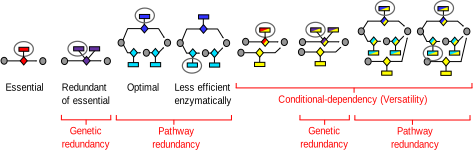
Sources of phenotypic robustness
We determined how many genes in each class contributed to robustness and which of them were under control of the VRN. Results are shown for two representative phenotypic traits: one belongs to the housekeeping functions (proliferation) and the other to the virulence-associated functions (T3SS). These phenotypes were selected since they are dependent on a significant number of regulated genes (78) so the specific distribution of regulated genes into classes can be well discriminated from random. For the proliferation phenotype, the analysis revealed that a majority (up to 70%) of the VRN-dependent genes belongs to redundant pathways that are dependent on environmental conditions (class OPT-C and ELE-C). Such ‘environment–dependent’ genes can be optimal for the expression of a given phenotype in one environmental condition but not in another. On the other hand, only 10% of the VRN-controlled genes were essential genes or back-up genes for essential reactions (panels ESS and RED, respectively). Similarly to the proliferation function, the robustness of the T3SS phenotype mainly relied on redundant pathways that are dependent on environmental conditions (53 / 78 genes being controlled by the VRN). However, this analysis also showed that the VRN controlled a high number of essential genes for several virulence-associated functions and the distribution of the VRN-controlled genes in the different class for virulence-associated functions significantly differs from the distribution of gene of the proliferation function (chi-test p-value 5.2∙10-5). These essential genes belong to distinct virulence pathways, i.e they are different and not shared between the virulence-associated phenotypes
Classification of genes involved in robustness patterns (see legend above). Select the phenotype that you want to visualise. The values are in percent. Put the mouse over the points to get details.